Fewer Interruptions, More Bay Time: How One Retailer Unlocked Technician Capacity Without Adding Headcount

A multilocation automotive retailer operating high-volume service departments sought to increase service throughput while managing labor availability and cost variability.
Within this environment, technician productivity was the primary driver of output, with the most value created when technicians remained in their bays performing revenue producing work. However, internal logistics—particularly parts delivery and core returns—consistently interrupted that work, causing productivity losses to accumulate throughout the day.
To address this, the organization evaluated ways to reduce internal friction—particularly parts movement and core returns—and ultimately selected automated parts movement for further evaluation within the service environment.
The Pressure Point: Manual Parts Movement Introducing Hidden Costs
Before deployment, internal service workflows varied by store, but several consistent pain points emerged:
- Technicians frequently left their bays to retrieve parts or waited at the parts counter
- Stores averaged 1–3 parts trips per repair order, each estimated at ~12 minutes
- Technicians lost approximately 20–50 minutes per day per technician to parts movement and counter congestion
- Peak service windows—especially mornings and post lunch—created pronounced bottlenecks at the parts counter
These inefficiencies did not halt operations, but they introduced persistent friction:
- Lost productive bay time
- Labor cost variability tied to runner availability
- Throughput constraints during peak demand
The systems continued to function, but with built-in inefficiencies that limited technician productivity and overall service throughput.
The Decision: Focus on Specific Operational Constraint
Rather than attempting broad automation across fixed operations, the organization focused on a narrow, high-impact opportunity: automating internal parts delivery and core return with robotics.
This decision was guided by clear criteria:
- Increase technician availability without adding headcount
- Reduce dependency on dedicated parts runners
- Preserve safety and existing technician workflows
- Validate feasibility inside live, revenue-generating dealerships
Robotics was evaluated not as a replacement for people, but as a tool to handle repetitive internal movement—removing friction from the system rather than reshaping it.
The Approach: A Controlled Pilot in Live Dealership Operations
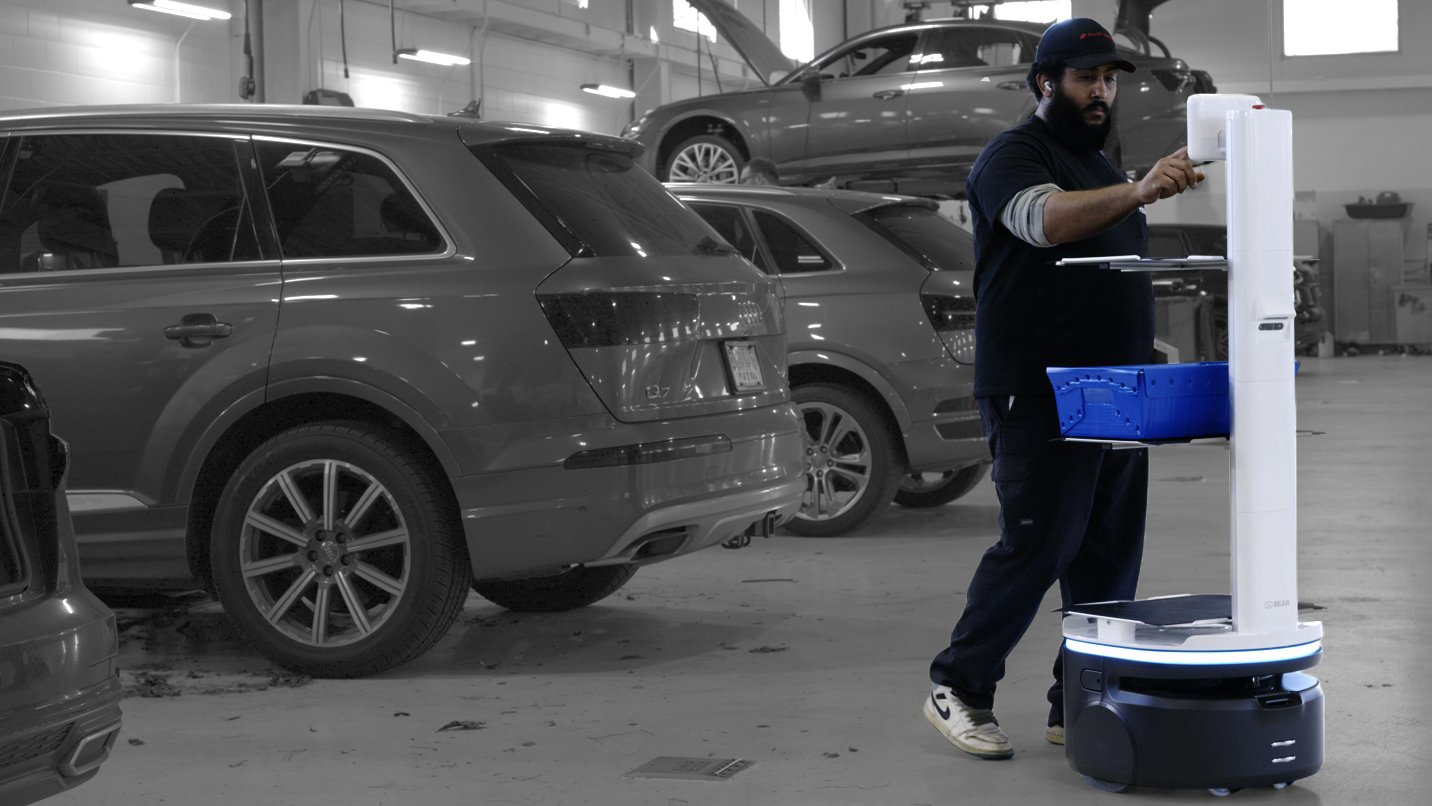
A pilot deployment was launched within an operating dealership environment, using an autonomous mobile robot (AMR) to handle internal parts delivery between the parts counter and service bays.
Key deployment elements included:
- A retail-appropriate AMR configured for indoor material handling
- Predefined delivery routes with multiple bay stops per run
- Human touchpoints retained for parts pulling and technician retrieval
Robot selection focused on the most effective robot that could move most parts, not all parts, to hit an optimal ROI curve. Certain activities were also intentionally excluded, including oversized or fragile components (e.g., glass) and technician-to-technician handoffs. These exclusions were made to preserve safety, control complexity, and support ease of deployment.
Adoption was reinforced by dealership leadership through usage expectations, utilization review, and visible support—positioning the deployment as an operational improvement rather than an experimental test.
The Impact: Early Operational Indicators (First 30 Days)
During the first 30 days of operation, the pilot produced measurable early indicators.
Technician Productivity
The robot completed 515 internal deliveries, eliminating approximately 24,000 steps walked by technicians and parts staff.
Based on conservative internal assumptions (estimating just one minute saved per delivery at the parts counter) the deployment indicated the potential to unlock approximately $4,800 in additional gross capacity during that period. More typical time assumptions (~4 minutes per delivery), suggest increased impact.
Workflow Stability
Automation reduced parts delivery delay variance during peak windows, improving consistency and reducing congestion at the parts counter. Parts managers reported smoother internal flow, particularly during high-volume periods.
Labor Utilization
Early data indicated that the robot handled 70%+ of parts delivery volume when being fully utilized, offsetting a substantial portion of dedicated runner tasks at a fraction of the operating cost. Utilization dropped on low-volume days, reinforcing the importance of aligning deployment with service demand and store layout.
Usage metrics were tracked through the Holman Robotics Connect portal, with dealership-specific parameters customizable to reflect local workflows and labor assumptions.
What Was Learned: Conditions for Success
The pilot clarified several critical success factors:
- Leadership reinforcement matters: sustained utilization required active management attention
- No uniform deployment model exists: layout, bay distance, and service volume materially affect outcomes
- Volume matters: robotics delivered the most value in stores with 30+ bays, consistent service backlog and peak-hour congestion
The deployment also revealed constraints:
- Connected environments are required (e.g., automated doors in some layouts)
- Robots are best suited for most—not all—parts movement
- Workflow alignment matters more than technology novelty
Looking Ahead: Scaling With Operational Discipline
Based on early operational indicators, the retailer is evaluating broader deployment across locations with similar operating characteristics.
Rather than treating robotics as a universal solution, the organization is applying a structured fit-assessment to determine where automation can reliably unlock technician capacity and stabilize workflow.
By grounding decisions in observed operational performance instead of assumptions, the organization established a framework for scaling robotics adoption with greater confidence and control, while maintaining service quality.
Gain Access Here
Related Resources
Explore more related industry news, insights, and developments.